AI Transformation Company Culture: A Strategic Leadership Guide
Learn how to lead a successful AI transformation company culture shift without sacrificing your core values. This guide explores the intersection of ethics, leadership, and scale.
By Dakota Rea ·
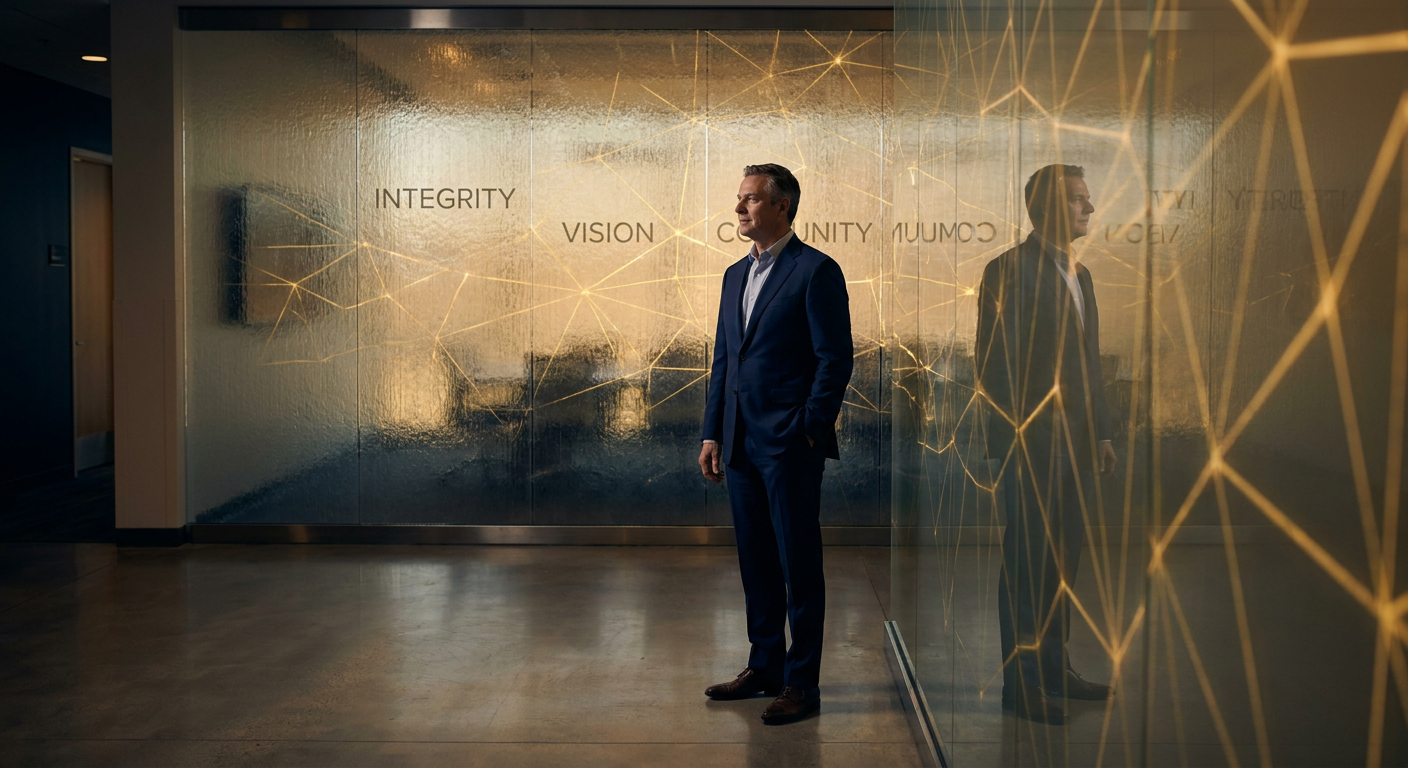
AI Transformation Company Culture: Leading High-Performance Teams
> **Key Takeaways**
> - "Culture is the silent architect of AI efficacy; ignoring it ensures technical debt becomes cultural decay."
> - "Treat AI as a cognitive collaborator rather than a replacement to maintain institutional trust."
> - "Transparency regarding algorithmic logic is the only way to prevent the erosion of professional autonomy."
> - "Upskilling must be framed as an expansion of human potential, not a remediation of human obsolescence."
> - "The most successful AI transitions prioritize social capital over immediate computational efficiency."
> **Dakota's Take**
>
> *"Most organisations I advise are asking the wrong question about ai leadership — they focus on the technology and forget the operating model. The real transformation happens when leadership stops treating AI as an IT project and starts treating it as a strategic capability that touches every corner of the business."*
>
> *— Dakota Rea, AI Strategy Consultant*
> **"Leadership in the age of automation requires a return to the fundamentals of human agency. If the algorithm dictates the strategy, the executive becomes a mere spectator in their own firm. True transformation is not about replacing the human heart of an organization, but about augmenting its pulse with precision silicon."**
>
> *— Dakota Rea, AI Strategy Consultant*
According to a 2024 Gartner report, 70% of AI initiatives fail not due to technical limitations, but because leaders neglect the **AI transformation company culture** required for sustained adoption. As a Harvard Business School graduate and AI Research Fellow, I have observed that the friction between legacy values and algorithmic speed is the primary killer of innovation in the Fortune 500. Leading an **AI leadership culture** requires more than just procurement; it requires a philosophical shift in how we define value, productivity, and human contribution. The rush to automate often blinds executives to the underlying social fabric that makes a company resilient. Without a clear strategy for **preserving culture AI change**, organizations risk becoming efficient but hollow shells of their former selves. In this guide, you'll discover the frameworks for implementing a **people-first AI** strategy that scales without compromising the integrity of your workforce or your mission.
**Table of Contents**
1. The Efficiency Trap and Cultural Erosion
2. The Benthamite Framework for Human-Centric AI Transformation
3. Critical Pitfalls in Digital Transformation Culture
4. Real-World Applications of Cultural AI Alignment
5. The Road Ahead: 2025-2026 AI Leadership Trends
6. Frequently Asked Questions
The Efficiency Trap and Cultural Erosion
The most significant threat to a successful **AI transformation company culture** is the "Efficiency Trap." Many organizations view AI solely through the lens of cost reduction and headcount optimization. However, a 2023 study by the World Economic Forum (WEF) found that companies focusing exclusively on cost-cutting through automation saw a 25% decrease in long-term employee engagement. When the workforce perceives AI as a threat to their livelihood rather than a tool for their empowerment, the resulting **AI culture change** is characterized by fear, data poisoning, and quiet resistance.
In my consulting engagements with enterprise clients across 60+ countries, I’ve seen that the most resilient cultures are those that treat AI as an extension of human capability. Cultural erosion occurs when the "why" of the organization is buried under the "how" of the technology. To avoid this, leaders must address the following friction points:
* **Loss of Agency:** Employees feel like cogs in an algorithmic machine.
* **Knowledge Siloing:** AI tools are implemented without cross-departmental conversation.
* **Ethical Dissonance:** The speed of AI outpaces the company's stated moral values.
* **Shadow AI:** Employees use unsanctioned tools because the official **digital transformation culture** is too rigid.
To lead effectively, one must recognize that **AI leadership culture** is not about managing software, but about managing the human response to that software. We must move beyond the binary of "human vs. machine" and toward a synthesis where the machine handles the mundane, and the human handles the meaningful.
The Benthamite Framework for Human-Centric AI Transformation

Drawing from my work as a Jeremy Bentham Scholar at the University of Oxford, I have developed a framework for **AI transformation company culture** that prioritizes the "greatest good" for the organizational ecosystem. This approach ensures that technical progress does not come at the expense of human dignity.
### Step 1: The Cognitive Mapping Phase
Before a single line of code is deployed, leaders must map the cognitive load of their teams. Identify which tasks are "draining" (repetitive, low-value) and which are "sustaining" (creative, strategic). A **people-first AI** approach begins by automating the draining tasks to liberate human energy for sustaining ones. This creates immediate buy-in because the value proposition to the employee is clear: less drudgery, more impact.
### Step 2: Establishing Algorithmic Transparency
Trust is the currency of culture. If employees do not understand how an AI tool reaches a decision—whether it’s a hiring algorithm or a supply chain forecast—they will not trust it. Implementing a policy of radical transparency regarding data inputs and logic gates is essential for **preserving culture AI change**. This aligns with the MIT AI Ethics & Governance standards, ensuring that accountability remains with human stakeholders.
### Step 3: Redefining Performance Metrics
Legacy KPIs often reward sheer volume, which AI can easily manipulate. An **AI leadership culture** requires new metrics that value judgment, ethical oversight, and cross-functional collaboration. We must shift from measuring "output" to measuring "outcome and insight." This prevents the workforce from feeling like they are competing against a machine they can never out-produce.
### Step 4: Continuous Ethical Auditing
Transformation is not a one-time event. It requires a recurring feedback loop where employees at all levels can report cultural friction points caused by AI. This "Human-in-the-loop" governance model ensures that the **digital transformation culture** remains aligned with the company’s core mission as the technology evolves.
Critical Pitfalls in Digital Transformation Culture
Even the most well-intentioned leaders can stumble when navigating **AI culture change**. Through my years of executive education at Wharton and HBS, I have identified four critical pitfalls that consistently derail transformation efforts.
**The Black Box Leadership Gap** occurs when executives delegate AI strategy entirely to the IT department. AI is a fundamental business shift, not a technical one. When leadership lacks a basic understanding of the technology's limitations, they cannot set a cultural tone of realistic expectation. This leads to "AI disillusionment" when the tools fail to meet hyperbolic promises.
**The Skills Gap Denial** is the assumption that employees will naturally adapt to new tools without structured support. A **people-first AI** strategy requires a massive investment in upskilling. Without it, you create a two-tier workforce: those who can speak "AI" and those who are left behind. This disparity is toxic to a unified **AI transformation company culture**.
**The Metric Obsession** involves prioritizing short-term computational gains over long-term organizational health. If your AI increases throughput by 40% but increases employee burnout by 60%, the transformation is a failure. Leaders must resist the urge to optimize for the machine at the expense of the human spirit.
**The Opaque Governance Pitfall** is the failure to define who is responsible when the AI makes a mistake. In a healthy **AI leadership culture**, the lines of accountability are crystal clear. When they are blurred, a culture of blame emerges, stifling innovation and risk-taking.
Real-World Applications of Cultural AI Alignment

In the **Financial Services** sector, I recently worked with a global bank that was struggling with its **AI transformation company culture**. They had implemented an AI-driven credit scoring model that their loan officers were quietly bypassing. By applying the Benthamite framework, we discovered the officers felt the AI lacked "contextual empathy." We redesigned the workflow to allow officers to add "qualitative overrides," which the AI then learned from. This preserved the professional autonomy of the staff while increasing the accuracy of the model.
In **Healthcare**, the challenge is often one of **preserving culture AI change** amidst high-stakes decision-making. A major diagnostic imaging firm I advised found that radiologists were skeptical of AI-assisted detection. By reframing the AI as a "second set of eyes" rather than a replacement, and by involving the radiologists in the training of the models, we fostered a **people-first AI** environment that significantly reduced diagnostic errors without causing staff turnover.
**Manufacturing** companies often face the steepest climb in **digital transformation culture**. At a Fortune 500 automotive supplier, we integrated predictive maintenance AI not just to save money, but to improve worker safety. By centering the cultural narrative on "Safety Through Intelligence," the floor workers became the biggest advocates for the technology, rather than its detractors. This demonstrates that when AI serves the human, the culture naturally follows.
The Road Ahead: 2025-2026 AI Leadership Trends
As we look toward 2025 and 2026, the focus of **AI leadership culture** will shift from "adoption" to "integration." We are moving into an era of Agentic AI, where autonomous systems will not just suggest actions but take them. This will require an even more robust **AI transformation company culture** focused on high-level oversight and ethical governance.
I predict the rise of the "Chief AI Ethics Officer" as a standard C-suite role, bridging the gap between technical capability and cultural integrity. Furthermore, the concept of "Cognitive Diversity" will expand to include how humans and AI agents interact. Organizations that master this interaction will outperform their peers by a significant margin. The goal for 2026 is not just to have a digital strategy, but to have a **digital transformation culture** that is inherently adaptable.
We will also see a move away from generic AI models toward proprietary, culturally-aligned Small Language Models (SLMs). These models will be trained not just on public data, but on the unique institutional knowledge and values of the specific firm. This will make **preserving culture AI change** easier, as the technology itself will be a reflection of the company’s specific ethos and history.
Frequently Asked Questions
### How do you start an AI transformation company culture shift?
Begin by identifying the specific anxieties of your workforce. A successful shift starts with transparent communication about why the AI is being introduced and how it will augment, rather than replace, human roles. Leadership must model the use of these tools and provide clear pathways for upskilling to ensure no one is left behind.
### Why does AI leadership culture fail in traditional industries?
Failure often stems from a lack of technical literacy at the executive level and a rigid adherence to legacy hierarchies. Traditional industries tend to view AI as a threat to established expertise. Overcoming this requires reframing AI as a tool that enhances professional judgment rather than one that automates it away.
### What is the role of preserving culture AI change?
Preserving culture ensures that the core values and unique identity of a company remain intact during rapid technological shifts. It acts as a stabilizer, preventing the organization from losing its competitive advantage—which is often the "human element" that AI cannot replicate, such as empathy, complex ethics, and strategic intuition.
### How can we ensure a people-first AI approach?
Ensure a people-first approach by involving employees in the selection and training of AI tools. Prioritize automation that removes repetitive tasks, and reinvest the saved time into employee development and creative problem-solving. Always maintain a "human-in-the-loop" for critical decisions to ensure accountability and ethical alignment.
### When should a company hire an AI strategy consultant?
A company should hire a consultant when they experience high internal resistance to new technology, when their AI pilots fail to scale, or when they lack a clear ethical framework for implementation. A consultant provides the objective, global perspective needed to align technical goals with long-term cultural health.
Transform Your AI Strategy With Expert Guidance
Navigating the complexities of **AI transformation company culture** requires a partner who understands both the silicon and the soul of a business. My consulting approach combines Harvard-trained strategic rigor with Oxford-inspired ethical frameworks to ensure your AI journey is both profitable and principled. Visit my /consulting page to learn how we can build a resilient, **people-first AI** future for your organization that drives measurable growth while honoring your team's unique value.