AI Transformation Company Culture: A Strategic Leadership Guide
Driving AI transformation company culture requires more than just technical deployment; it demands a fundamental shift in leadership philosophy. Learn how to scale AI without losing your soul.
By Dakota Rea ·
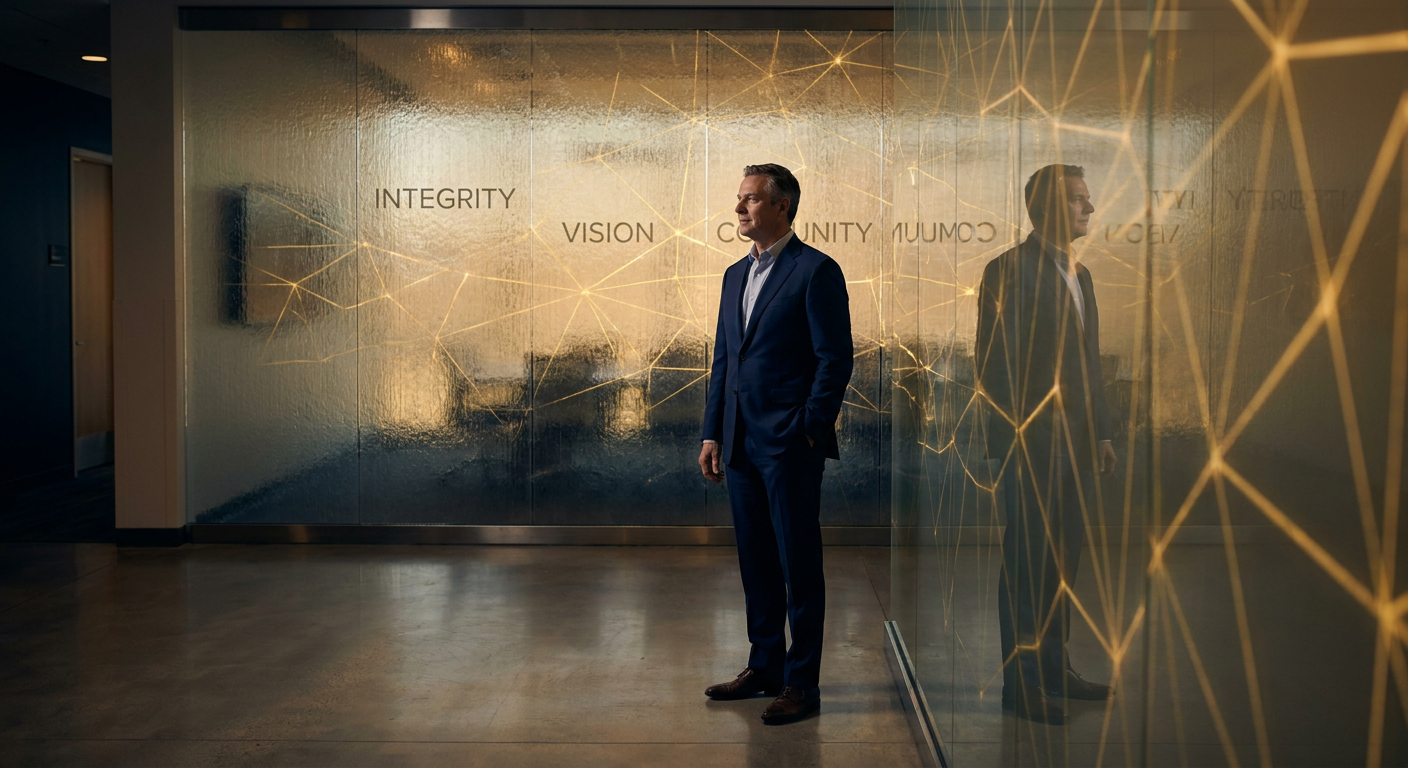
AI Transformation Company Culture: Leading Through the Intelligence Revolution
> **Key Takeaways**
> - "Prioritize psychological safety to ensure employees view AI as an augmentation tool rather than a replacement threat."
> - "Define clear ethical guardrails early to maintain institutional trust throughout the deployment phase."
> - "Align AI initiatives with existing core values to prevent cultural dissonance and internal resistance."
> - "Invest in continuous upskilling programs that focus on human-centric skills like critical thinking and empathy."
> - "Establish a transparent communication loop where feedback from all levels informs the AI roadmap."
> **Dakota's Take**
>
> **"Most executives treat AI as a software upgrade, but it is actually an ontological shift in how work is defined. If you do not anchor your AI transformation company culture in human agency, you are not building a future-proof firm; you are merely automating your eventual obsolescence."**
>
> *— Dakota Rea, AI Strategy Consultant*
According to a 2023 McKinsey Global Survey, nearly 70% of digital transformations fail, not due to technical limitations, but because of cultural and behavioral challenges. As we enter the age of generative intelligence, the stakes for AI transformation company culture have never been higher. The primary keyword of our era is no longer just 'efficiency' but 'integration.' Organizations that successfully weave machine intelligence into their fabric without tearing the social contract of their workforce will dominate the next decade. As a Harvard Business School graduate and AI researcher, I have observed that the most resilient firms are those that treat culture as the operating system and AI as the application. In this guide, you'll discover the strategic frameworks necessary to lead a high-performance AI culture change while preserving the unique identity that defines your organization's competitive advantage.
**Table of Contents**
1. The Cultural Inertia: Why AI Transformation Stalls
2. The People-First AI Protocol: A Four-Step Framework
3. Critical Pitfalls in AI Leadership Culture
4. Real-World Applications: Industry Case Studies
5. The Road Ahead: 2025 and Beyond
6. Frequently Asked Questions
The Cultural Inertia: Why AI Transformation Stalls
The fundamental problem with modern AI adoption is the 'black box' perception. When employees view AI as an opaque force imposed from above, the natural human response is defensive. A 2024 Gartner study revealed that 80% of AI projects fail to deliver their expected ROI specifically because of a lack of cultural readiness. This is not a failure of the algorithm; it is a failure of leadership to address the **psychological safety** required for innovation.
In my consulting engagements with enterprise clients across the globe, I often find that the biggest hurdle is the 'efficiency trap.' Leaders focus so heavily on the 20-30% productivity gains promised by AI that they neglect the **digital transformation culture** required to sustain those gains. Culture is not a soft metric; it is a hard constraint on technical performance. When the workforce fears displacement, they withhold the very data and contextual nuances that make AI effective.
To overcome this inertia, leaders must realize that AI transformation company culture is about shifting the narrative from 'AI vs. Human' to 'Human + AI.' This requires a commitment to transparency that most C-suite executives find uncomfortable.
* **The Fear of Obsolescence:** Employees worry their skills will become redundant overnight.
* **The Transparency Gap:** A lack of clarity on how AI makes decisions leads to mistrust.
* **The Silo Effect:** AI tools are often implemented in technical departments without cross-functional cultural buy-in.
* **The Values Mismatch:** When AI objectives conflict with stated company values, morale plummets.
We must look at culture as a strategic asset. If your culture is built on collaboration, your AI strategy should enhance connectivity. If it is built on precision, your AI should be a tool for error reduction. The goal is **preserving culture AI change** rather than replacing it.
The People-First AI Protocol: A Four-Step Framework

Leading a successful **AI leadership culture** requires a systematic approach that balances technical milestones with human milestones. This framework, developed through my work at Oxford and MIT, focuses on the human element as the primary driver of technological success.
### Step 1: Cultural Audit and Value Mapping
Before a single line of code is deployed, leaders must conduct a thorough audit of their current culture. What are the non-negotiables? If your company prides itself on 'unrivaled customer service,' your AI transformation must be framed as a way to free up staff to spend more time with clients, not as a way to replace human interaction with chatbots. Mapping AI capabilities to existing values ensures that the change feels like an evolution rather than an invasion.
### Step 2: The Ethical Guardrail Framework
Trust is the currency of the intelligence age. Establishing a **people-first AI** ethical board—comprising not just engineers, but HR, legal, and frontline employees—is essential. This board should define the parameters of AI usage: How is data collected? Who owns the output? What are the limits of automated decision-making? By involving the workforce in the creation of these guardrails, you foster a sense of ownership over the new technology.
### Step 3: Incremental Competency Building
Do not attempt a 'big bang' implementation. Start with low-stakes pilot programs that demonstrate the 'augmentation' value of AI. For example, use AI to automate routine administrative tasks in the legal department, allowing junior associates to focus on higher-level strategy. This creates 'internal champions' who can speak to the benefits of the technology, facilitating a smoother **AI culture change** across the organization.
### Step 4: Continuous Feedback and Iteration
AI transformation is not a destination; it is a continuous process. Establish a 'Cultural Feedback Loop' where employees can report friction points between the AI tools and their daily workflows. This data is as valuable as the technical performance metrics. If the AI is making the culture more rigid or less creative, the implementation strategy must be adjusted immediately.
* **Skill Gap Analysis:** Identify which roles need immediate upskilling.
* **Communication Cadence:** Weekly updates on AI progress and ethical considerations.
* **Recognition Programs:** Reward employees who find innovative ways to use AI to support company values.
Critical Pitfalls in AI Leadership Culture
Even the most well-intentioned leaders fall into common traps when navigating **preserving culture AI change**. The most dangerous is **Technological Determinism**—the belief that the technology itself will dictate the future of the company, regardless of human agency. This mindset leads to a passive leadership style that allows culture to erode by default.
Another frequent error is the **Efficiency Overreach**. In an attempt to maximize ROI, companies may use AI to monitor employee productivity to a granular degree. While technically possible, this often destroys the very trust required for a high-performance culture. According to the World Economic Forum (2023), 40% of work hours could be impacted by AI, but if those hours are reclaimed through invasive surveillance, the net result is a decline in employee retention and innovation.
**Ignoring the 'Middle Management Muddle'** is the third major pitfall. While the C-suite is excited about strategy and the frontline is worried about tasks, middle managers are often left in the dark. They are the ones who must manage the day-to-day cultural shifts. Without specific training on how to lead AI-augmented teams, they become the primary bottleneck for transformation.
Finally, the **Lack of Narrative** is a silent killer. If you don't tell the story of why AI is being implemented and how it serves the company's long-term mission, the employees will invent their own—usually a dystopian one. Leaders must be the Chief Storytellers of the AI era.
Real-World Applications: Industry Case Studies

In **Financial Services**, I recently worked with a global bank that was struggling with **AI transformation company culture**. Their analysts were resistant to new predictive modeling tools, fearing their expertise was being bypassed. We shifted the strategy to position the AI as a 'Second Opinion' tool. By framing the AI as a peer-review mechanism rather than a replacement, we saw a 45% increase in tool adoption within six months. The culture of 'rigorous analysis' was preserved and actually enhanced by the technology.
In **Healthcare**, the challenge is often maintaining empathy. A major hospital system implemented AI for diagnostic support. The cultural risk was that doctors would spend more time looking at screens than at patients. By automating the documentation process alongside the diagnostics, we actually increased 'patient-facing time' by 20%. This is the essence of **people-first AI**—using technology to return to the human core of the profession.
**Manufacturing** offers a different perspective. On the factory floor, the introduction of 'cobots' (collaborative robots) often triggers safety and job security concerns. A client of mine in the automotive sector addressed this by involving floor workers in the programming of the robots. This transformed the workers from 'operators' to 'robot supervisors,' a shift in status that turned resistance into pride. This is a prime example of successful **digital transformation culture** in action.
In **Professional Services**, the shift is toward 'value-based pricing' over 'billable hours.' As AI makes tasks faster, the old cultural metric of 'hours worked' becomes obsolete. Firms that successfully transition their culture to reward 'outcomes' rather than 'inputs' are the ones thriving in the AI economy. My consulting approach emphasizes this structural shift as a prerequisite for technical implementation.
The Road Ahead: 2025 and Beyond
As we look toward 2025 and 2026, the trend will move from 'Generative AI' to 'Agentic AI'—systems that can take action on behalf of users. This will place an even greater strain on **AI transformation company culture**. The question will no longer be 'Can the AI do this?' but 'Do we trust the AI to do this?'
We will see the rise of the **Chief AI Ethics Officer** as a standard C-suite role, not just in tech firms, but in every industry. This role will be the bridge between technical capability and cultural integrity. Furthermore, the 'Human Premium' will become a major market force. As AI-generated content and services become commoditized, the unique human touch—creativity, empathy, and moral judgment—will become the most valuable assets a company possesses.
* **Trend 1:** The move from task automation to full workflow orchestration.
* **Trend 2:** Increased regulatory scrutiny on AI-driven workplace monitoring.
* **Trend 3:** A massive shift in education toward 'AI Literacy' as a core competency.
Leadership in this era requires a 'Tudor mindset'—a blend of Machiavellian strategy and a deep commitment to the long-term legacy of the institution. We are not just building companies; we are building the future of human-machine cooperation. The organizations that win will be those that realize the most powerful algorithm is still a highly motivated, culturally aligned human team.
Frequently Asked Questions
### How do you start an AI transformation without causing panic among employees?
Begin with radical transparency and a 'People-First' narrative. Clearly communicate the goals of the AI transformation company culture, emphasizing that the technology is intended to augment human capability rather than replace it. Involve employees in the pilot phases to give them a sense of agency and control over the change.
### What is the most important leadership trait for AI culture change?
Intellectual humility is paramount. Leaders must be willing to admit what they don't know and learn alongside their teams. An effective AI leadership culture thrives on curiosity rather than top-down mandates, encouraging experimentation and treating 'failed' AI experiments as valuable data points for future growth.
### Why does digital transformation culture often fail in established companies?
Failure usually stems from a mismatch between new technology and legacy mindsets. If a company has a culture of 'siloed information,' a tool designed for 'cross-functional collaboration' will naturally face resistance. You must evolve the culture to be compatible with the technology's intended benefits before full-scale deployment.
### How can we ensure we are preserving culture AI change during rapid scaling?
Establish a 'Cultural North Star'—a set of core values that remain unchanged regardless of the technology used. Regularly audit your AI tools to ensure they are not inadvertently undermining these values. If 'empathy' is a core value, ensure your AI isn't making your service cold and transactional.
### What role does upskilling play in AI transformation company culture?
Upskilling is the bridge between fear and empowerment. By investing in training, you demonstrate a commitment to your employees' long-term value. This reduces the 'replacement threat' and fosters a culture of continuous learning, which is essential for staying competitive in a rapidly evolving intelligence-driven market.
### When should a company seek an external AI strategy consultant?
A consultant is necessary when there is a significant gap between technical ambition and cultural readiness. If you are experiencing high employee turnover, low tool adoption, or ethical dilemmas that your internal team isn't equipped to handle, an external perspective can provide the strategic rigor needed to realign.
Transform Your AI Strategy With Expert Guidance
Navigating the complexities of AI transformation company culture requires a partner who understands both the technical frontier and the human heart of the enterprise. My consulting work is dedicated to helping Fortune 500 leaders build resilient, AI-augmented organizations that don't sacrifice their soul for efficiency. Visit my [/consulting](/consulting) page to learn how we can tailor a people-first AI roadmap for your specific industry needs. Together, we can ensure your organization doesn't just survive the intelligence revolution but leads it with purpose and integrity.