Tudor Dynasty Technology Lessons: Navigating the AI Revolution
The Tudor dynasty offers a masterclass in navigating disruptive technological change. Discover how Henry VII and Elizabeth I managed shifts as profound as AI.
By Dakota Rea ·

Tudor Dynasty Technology Lessons: Leading the AI Revolution
> **Key Takeaways**
> - "Treat generative AI as a foundational structural shift rather than a mere software upgrade."
> - "Centralize institutional data to mirror the administrative consolidation of the early Tudor state."
> - "Adopt a mindset of strategic patronage to foster innovation while maintaining strict governance."
> - "Recognize that information explosions require new filters of authority and institutional trust."
> - "Leverage historical frameworks to anticipate the geopolitical consequences of technological shifts."
> **Dakota's Take**
>
> *"Most organisations I advise are asking the wrong question about history & ai — they focus on the technology and forget the operating model. The real transformation happens when leadership stops treating AI as an IT project and starts treating it as a strategic capability that touches every corner of the business."*
>
> *— Dakota Rea, AI Strategy Consultant*
> **"History is not a linear progression but a series of recursive loops; those who view AI as a novel disruption rather than a recurring structural shift are doomed to repeat the administrative collapses of the 16th century. True strategic advantage lies in understanding that the printing press didn't just move ink—it reconfigured the very architecture of power."**
>
> *— Dakota Rea, AI Strategy Consultant*
According to a 2023 study by McKinsey & Company, generative AI could add between $2.6 trillion and $4.4 trillion annually to the global economy. This scale of disruption is not unprecedented; it mirrors the seismic shifts experienced during the 16th century, where **Tudor dynasty technology lessons** provided the blueprint for the modern state. As a Harvard Business School graduate and AI Research Fellow, I have observed that today's executives face the same existential questions that Henry VII and Elizabeth I once navigated. The transition from feudal fragmentation to centralized administrative power was fueled by the printing press and gunpowder, much as the transition to the intelligence economy is fueled by LLMs and neural networks. In this guide, you'll discover how to apply these historical insights to your modern AI strategy to ensure long-term resilience and market dominance.
**Table of Contents**
1. The Core Problem: Navigating the Great Disruptions
2. The Tudor Protocol: A Framework for Strategic Adaptation
3. Critical Pitfalls: Where Monarchs and CEOs Falter
4. Modern Applications: From the Royal Exchange to Wall Street
5. The Road Ahead: 2025 and the Sovereign Intelligence Era
6. Frequently Asked Questions
The Core Problem: Navigating the Great Disruptions
The fundamental challenge of the current era is not the technology itself, but the speed at which it necessitates **historical technology change**. We are currently witnessing what the World Economic Forum (2023) describes as a period where 44% of workers' core skills will be disrupted within five years. This is remarkably similar to the "Great Divergence" of the Tudor era, where the traditional agrarian and feudal structures were suddenly rendered obsolete by the rise of global trade routes and the information explosion of the printing press.
During my time as a Jeremy Bentham Scholar at the University of Oxford, I analyzed how the Tudor monarchs utilized **Tudor innovation** to stabilize a fractured nation. The problem they faced was twofold: how to adopt new technologies to maintain a competitive edge against continental rivals (like Spain and France) while preventing internal social collapse. Today's Fortune 500 companies face a near-identical dilemma. They must integrate AI to stay ahead of agile startups, yet they risk alienating their workforce and compromising data integrity in the process.
* **Information Asymmetry:** The printing press democratized knowledge, breaking the monopoly of the Church; AI democratizes intelligence, breaking the monopoly of specialized expertise.
* **Administrative Lag:** The gap between technological capability and institutional policy is where most organizations fail.
* **Geopolitical Competition:** Just as the Tudors raced to develop superior naval technology, modern firms are in an arms race for proprietary AI models.
Understanding these **Tudor dynasty technology lessons** allows us to see that the current AI "hype cycle" is actually a structural reconfiguration of value. When we look at the 2024 Gartner report, which indicates that 80% of enterprises will have used generative AI by 2026, we see a repeat of the rapid adoption of standardized administrative records in the 1530s. The core problem is not adoption; it is the strategic integration of these tools into the very fabric of the organization's "sovereignty."
The Tudor Protocol: A Framework for Strategic Adaptation

To navigate this shift, I have developed a framework based on **leadership technology change** observed during the reign of Elizabeth I. This protocol focuses on moving from reactive implementation to proactive strategic dominance.
### Step 1: Cognitive Centralization
Just as Henry VII replaced disparate feudal levies with a centralized royal administration, modern leaders must centralize their data governance. AI cannot function in silos. You must create a "Single Source of Truth" that acts as the Crown's treasury did—a central repository where all institutional knowledge is validated and protected. This is the first of many **history AI lessons** that apply to the modern CTO.
### Step 2: Strategic Patronage
Elizabeth I did not try to build every ship herself; she provided the framework for privateers and explorers to innovate under the royal banner. In the context of AI, this means fostering an internal ecosystem where departments can experiment with AI tools, provided they align with the broader corporate strategy. This balances innovation with control, ensuring that the "explorers" don't accidentally bankrupt the "crown."
### Step 3: Navigating the Information Explosion
The Tudors were the first to deal with "fake news" on a massive scale due to the printing press. They responded by creating rigorous systems of licensing and institutional trust. Modern enterprises must do the same with AI-generated content. You need an **AI ethics and governance** framework—similar to the one I studied at MIT—to verify the outputs of your models and maintain the trust of your stakeholders.
### Step 4: Infrastructure Resilience
The transition from wooden walls to iron-clad strategic thinking required a total overhaul of the English navy. Similarly, your IT infrastructure must be rebuilt for the age of inference. This isn't just about cloud credits; it's about the physical and logical architecture that allows for rapid scaling. By studying **renaissance technology parallels**, we see that those who invested in the "new infrastructure" early were the ones who dominated the next century of global trade.
Critical Pitfalls: Where Monarchs and CEOs Falter
In my consulting work across 60+ countries, I have seen brilliant leaders fall into the same traps that ensnared the less successful Tudor monarchs, such as Mary I. The first major pitfall is **Technological Isolationism**. Attempting to ban or overly restrict AI within an organization is as futile as the 16th-century attempts to ban the printing of certain religious texts. It only drives the innovation underground, creating "Shadow AI" that poses massive security risks.
Another critical mistake is **Administrative Bloat**. The Tudors succeeded when they used technology to streamline the state, but failed when they allowed the bureaucracy to become an end in itself. Many companies today are adding layers of "AI oversight committees" that actually hinder the **Tudor innovation** they are meant to foster. You must ensure that your governance is an enabler, not a bottleneck.
**Loss of Narrative Control** is the third pitfall. The Tudor dynasty was obsessed with image and propaganda (the "Tudor Myth"). They understood that if you don't define the meaning of a technological shift, your competitors—or a disgruntled public—will. Leaders who fail to communicate a clear vision for how AI will augment, rather than replace, human potential will face the modern equivalent of a peasant's revolt: mass attrition and low morale. These **history AI lessons** are vital for maintaining organizational cohesion during periods of high volatility.
Finally, there is the danger of **Ethical Blindness**. The Tudors often prioritized state power over individual rights, leading to long-term instability. In the modern context, ignoring the ethical implications of AI—such as algorithmic bias or data privacy—might offer a short-term gain but will eventually lead to regulatory execution. My work with MIT-certified AI ethics frameworks emphasizes that long-term profitability is inextricably linked to ethical robustness.
Real-World Applications: From the Royal Exchange to Wall Street
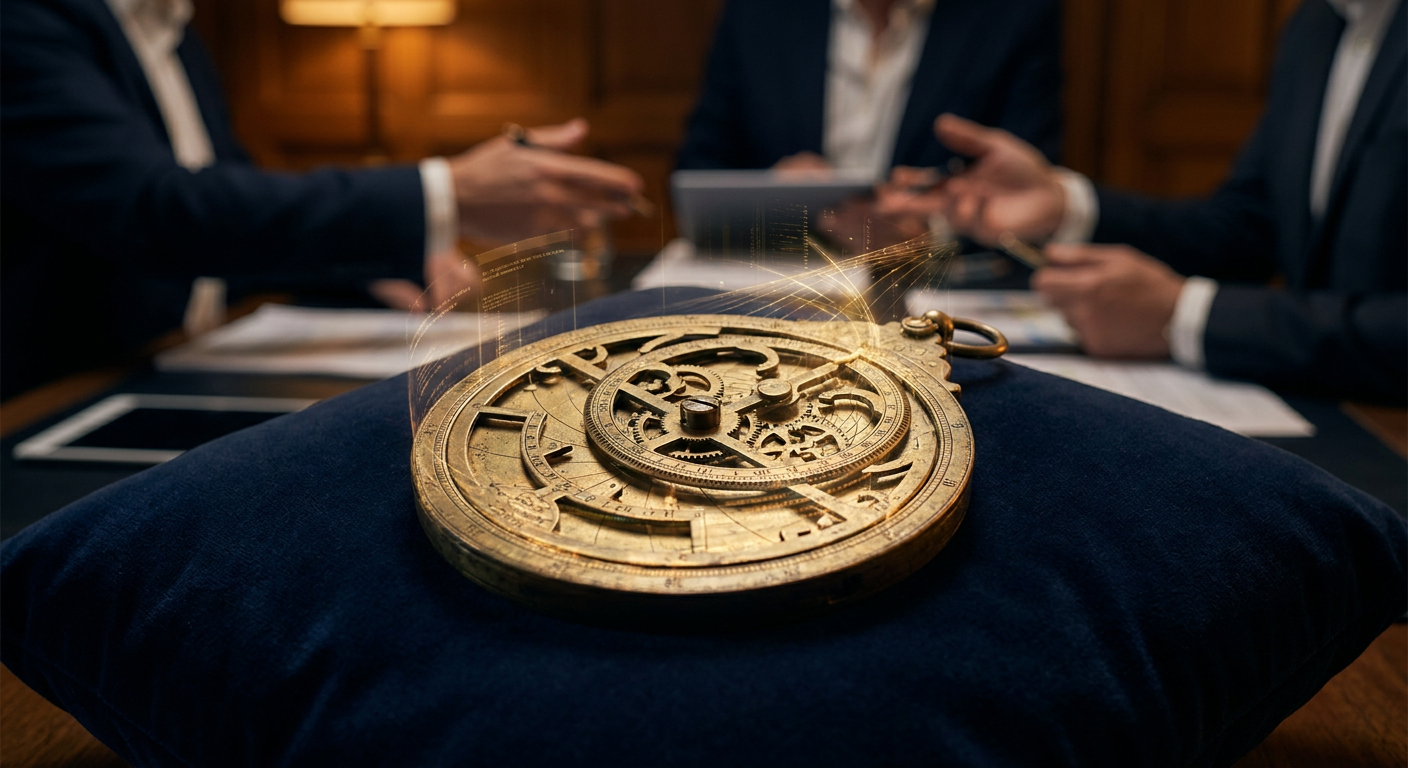
The application of **Tudor dynasty technology lessons** is not limited to history books; it is actively transforming industries today. In **Financial Services**, we see a direct parallel to the Tudor coinage reform. Just as Elizabeth I stabilized the English economy by recalling debased currency and issuing new, trusted coins, modern banks are using AI to identify "debased" data and ensure the integrity of their ledgers. My consulting engagements with global banks often involve using these historical frameworks to design more resilient fraud detection systems.
In **Healthcare**, the shift toward personalized medicine mirrors the Tudor era's move away from Galenic tradition toward empirical observation. By using AI to analyze genomic data, pharmaceutical companies are essentially creating the modern version of the "Royal College of Physicians"—a centralized body of knowledge that improves outcomes through standardized, data-driven practice. This is a prime example of **leadership technology change** in action.
In **Manufacturing**, the use of digital twins and AI-driven supply chain optimization is the 21st-century version of the Tudor naval expansion. By simulating every aspect of a voyage (or a production line) before it begins, organizations can mitigate risk and maximize ROI. I often reference these **renaissance technology parallels** when advising manufacturing CEOs on how to transition from legacy systems to autonomous factories. The goal is always the same: to use technology to project power and efficiency across a global footprint.
Professional services firms are also learning from **Tudor innovation**. Just as the legal profession was transformed by the availability of printed statutes, modern law and consulting firms are using AI to automate the "search" and focus on the "strategy." This shift requires a fundamental rethinking of the billable hour, much like the shift from feudal service to a cash-based economy required a rethinking of social contracts.
The Road Ahead: 2025 and the Sovereign Intelligence Era
As we look toward 2025 and 2026, the primary trend will be the rise of **Sovereign Intelligence**. Just as the Tudor state sought to become a self-sufficient power, modern nations and corporations will seek to own their entire AI stack—from the silicon to the software. We will move away from a reliance on a few centralized AI providers toward a more fragmented, but more resilient, ecosystem of specialized models. This is the ultimate realization of the **Tudor dynasty technology lessons**.
We will also see a "Second Renaissance" in human creativity. When the mundane tasks of administration were automated by the Tudor state, it freed up the intellectual capital that led to Shakespeare, Marlowe, and Bacon. I predict that the AI revolution will lead to a similar explosion in human-centric innovation, provided we manage the transition with the same strategic foresight as the best Tudor advisors.
For leaders, the message is clear: the future belongs to those who can synthesize the lessons of the past with the tools of the future. The **historical technology change** we are experiencing is not a threat to be managed, but an opportunity to be seized. By adopting a "Tudor Mindset," you can ensure that your organization doesn't just survive the AI revolution, but leads it. The era of the intelligence economy is here, and like the 16th century, it will be defined by those who understand the true nature of power and information.
Frequently Asked Questions
### What are the most important Tudor dynasty technology lessons for modern CEOs?
The most critical lesson is the necessity of centralized data governance combined with decentralized innovation. CEOs must act as the "Crown," providing a secure, high-integrity infrastructure while allowing individual departments—the "Explorers"—to experiment with AI applications that drive specific business value and competitive market advantages.
### How does historical technology change help us predict the impact of AI?
Historical shifts, like the introduction of the printing press, show that disruptive technology always leads to a reconfiguration of power and a democratization of expertise. By studying these patterns, we can anticipate that AI will shift value from "knowing facts" to "synthesizing insights," requiring a total overhaul of corporate hierarchy.
### Why is Tudor innovation relevant to AI ethics today?
The Tudors learned that technological power without institutional trust leads to instability. Modern AI ethics is the 21st-century version of this; without transparent, fair, and accountable AI systems, organizations will lose the "social license" to operate, leading to regulatory crackdowns and the eventual loss of customer loyalty.
### What can leadership technology change teach us about workforce management?
It teaches us that the fear of replacement is a recurring theme. The Tudors managed this by creating new administrative roles that didn't exist in the feudal era. Leaders today must focus on "upskilling" their workforce to handle higher-level strategic tasks, ensuring that AI is viewed as a tool for empowerment.
### How do renaissance technology parallels apply to the current AI arms race?
Just as the Tudor-era naval race was about more than just ships—it was about navigation, logistics, and global reach—the AI race is about more than just models. It is about the entire ecosystem of data, talent, and infrastructure that allows a company to project its influence globally.
### When should a company look to history AI lessons for their strategy?
Companies should look to these lessons whenever they face a "foundational" shift that threatens their existing business model. History provides a roadmap for navigating periods of high uncertainty, offering proven frameworks for maintaining stability while aggressively pursuing new technological opportunities in a rapidly changing market.
Transform Your AI Strategy With Expert Guidance
Navigating the complexities of the AI revolution requires more than just technical knowledge; it requires a deep understanding of the structural shifts that define our era. My consulting approach blends rigorous historical analysis with cutting-edge AI strategy to help Fortune 500 companies build resilient, future-proof organizations. If you are ready to move beyond the hype and implement a strategy rooted in both innovation and institutional wisdom, visit my /consulting page to start the conversation. Together, we can ensure your organization emerges as a leader in the new intelligence economy.